
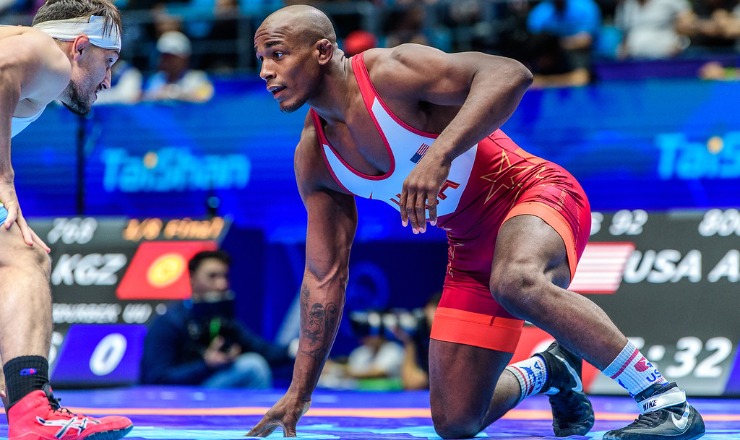
 J'den Cox at the 2019 World Championships (Photo/Tony Rotundo; WrestlersAreWarriors.com)
Just before the Olympic Trials started in Fort Worth, news began to ripple through the crowd that J'den Cox had missed weight and would not compete in the tournament. As a returning medalist at the non-Olympic weight of 92kg, Cox had a bye into the semifinals at 97kg. Many had anticipated a Saturday night matchup between Cox, a two-time world champion and 86kg Olympic medalist, and Kyle Snyder, the defending Olympic champion at 97kg and a two-time world champion.
As more information became public, it emerged that Cox claimed he was told the wrong weigh-in time by his coach, USA Wrestling National Freestyle Developmental Coach Kevin Jackson. Weigh-ins ended at 8:00am, but Cox did not make weight until 8:13am, according to published reports. The tournament committee met and decided that Cox could not enter, since he did not make weight in the time allotted. (Quick aside: international weigh-ins work differently than college. In college, wrestlers must be in the weigh-in area when the weigh-in begins or they cannot weigh in. Internationally, there is a weigh-in window, and wrestlers can come at any time during that window. The window ends two hours before wrestling begins.)
Cox was a serious threat to win the trials and medal in Tokyo this summer. Leaving him out of the tournament and depriving fans of the potential Cox vs. Snyder final generated a lot of discussion about whether or not Cox should have been permitted to wrestle even though he missed the weigh-in. At the heart of any discussion is the question of which rules really matter, and which rules are worth disregarding to reach a desired outcome. Is the desire to send the best possible team to Tokyo worth breaking a rule? Which rules are worthy of breaking and are then, by definition, less important than other rules? Would letting Cox wrestle allow him an unfair advantage, and is whether or not breaking a rule gives an advantage the only criteria worth considering when allowing a rule to be broken? These are hard questions to answer.
All athletic competitions are a distortion of reality. The rules create an artificial environment where certain regulations and procedures are agreed to by all competitors and enforced by officials. These rules include who is eligible to compete and how a competition takes place. Weight classes sort athletes by size. A takedown is worth two points. You must weigh in at a certain time to be in the tournament. Interlocking fingers is against the rules. Making weight two hours before the event begins is an arbitrary rule, but every wrestling rule is arbitrarily decided, and the competitors are tasked with knowing and understanding these rules so they can effectively compete in this specific version of distorted reality. Applying the rules differently to different competitors may create a result that is desirable to some while others disagree.
There is a value judgment that must be made anytime the rules are not applied in the way everyone had previously agreed to. In the case of Cox, is the potential of him winning an Olympic medal worth applying a separate set of rules to one athlete, possibly at the expense of others he may beat along the way?
Inherent in the belief that Cox should have been able to compete is the assertion that weighing in 13 minutes late should not disqualify a wrestler, or at least not disqualify a wrestler of Cox's quality. That leads to two more questions. First, how late is too late? If 8:13 is OK, what about 8:14? What about 8:45? Could he weigh-in after his first match? Second, how good does a wrestler need to be in order to merit an exception to the rules? Should only serious medal threats be granted exceptions? Who decides if someone is a serious medal threat? If this grace should only be extended to serious contenders, what happens if a low-seeded wrestler had shown up at 8:13? Would Cox be allowed to wrestle, but the other wrestler removed from the tournament? There is no value judgment in these questions; these are just questions that must be answered before deciding to grant one wrestler an exception to the rules. It is possible to determine that the desired end (getting a medal contender into the tournament) justifies the means (giving exceptional treatment to one competitor) in this case.
One level removed from whether or not Cox should have been able to wrestle is how that decision affects the other competitors at 97kg. A spot on the Olympic team was not the only prize last weekend in Fort Worth. Wrestlers competed for spots on the National Team. The top three athletes in each weight class receive financial support, training opportunities, and international competition slots. As of today, Kyle Snyder, Kollin Moore, and Kyven Gadson are 1, 2, and 3 on the national team ladder. Inserting Cox into the 97kg bracket could have resulted in one of those guys losing a national team spot and the others dropping down on the ladder, as well as losing the Olympic spot to a wrestler who did not follow the same rules as everyone else. One can argue that this is a worthwhile tradeoff to get the best team to Tokyo, but it is necessary to consider any potential loss, financial or otherwise, incurred by the other wrestlers in the bracket who followed the rules and weighed in on time.
Finally, it is worth considering the argument that Cox gained no benefit by weighing in late. This should not be automatically assumed true. He had less time to recover after the weigh-in than someone who weighed in earlier. On the other hand, he had more time to get his weight down than every other competitor. In the end, it doesn't really matter, which is true in this specific case. What matters more is the idea that breaking a rule should be overlooked if the competitor doing it is good enough and breaking the rule does not result in an unfair advantage to the rule breaker. This will create a hierarchy of rules where some are considered too important to break while others are more flexible. There is not necessarily anything wrong with this, but someone has to decide where the line is drawn. USA Wrestling decided that weighing in on time was important enough a rule to enforce it to the letter. Some may call that arbitrary, but as discussed earlier, all rules are arbitrary, and someone must be charged with making enforcement decisions.
Is it more important to treat all competitors fairly or equally, and who is the arbiter of fairness? Furthermore, when giving unequal treatment, how much notification should the other competitors receive? Snyder had a bye into the finals. Cox was to be given a bye to the challenge tournament semifinals. They were not treated equally to the other wrestlers at 97kg. However, USA Wrestling published the procedure for team selection months in advance, and everyone in the weight class knew ahead of time what it would take to make the Olympic team. Allowing Cox to weigh in late and still compete would have been more unequal treatment, but maybe it would not have been unfair to the other competitors. How one views this bit of potential unequal treatment may depend on whom it affects. A fan who wants to see both Cox vs. Snyder and the strongest possible team might be fine with it. Moore and Gadson, their coaches, and their fans might be less so, for reasons previously discussed.
What is the right thing to do in a scenario like this? USA Wrestling could bend the rules or stick to the published guidelines. The other 195 wrestlers in the challenge tournament made weight on time. One did not. The fact that the one is a world champion whose coach may have passed along some incorrect info complicates things further, and, no matter what anyone thinks of the situation, 13 minutes is not a long time. USA Wrestling made the call to hold everyone to the same weigh-in timing standard. That is a tough call to make when the result is disqualifying a world champion. There does not appear to be an easy, no-doubt-about-it answer, but the committee can at least say that they voted to uphold the published rules for conducting the tournament.
J'den Cox had indicated he will appeal the decision. He might win and get a chance to make the team. He might deserve that chance. Whoever hears his appeal will have to weigh all the evidence, and there are big questions that will be part of the deliberations. Which rules matter? Which rules can be bent or broken without damaging the fairness and integrity of the event, selection process, or sport?

I guess my solution, even though I said we should not interject, would be let the three wrestlers who have qualified vote by secret ballot, no names, yes or no. Majority rule, if he's in then he wrestles the 3rd place winner 1 match, if he wins, he wrestles the second place winner 1 match, if he wins, he wrestles a best of 3 that night. One day, he agrees to no further legal action and we get this done with the guys who it affects.
If my second pernt is the relevant pernt, that would be the MOST egregious act of unfairness, to just award Cox as a finalist and not have rassle his semi-finals opponent.
Someone else who got shafted was NIck Suriano. He got disqualified because of a positive Covid test. Wait until everyone discovers that the Corona Scamdemic was the largest hoax in the whole world. Less than 1 % die of it and they shut down the entire planet. See there was no common sense there. Do you honestly think that putting on a cloth mask on helps anything at all. What a complete and total joke. Every one who canceled all these plans in the last year!. Like last years NCAA tournament.
When everyone finally discovers the truth about Covid they will be livid, except for the people who where 3 masks. lol they are just idiots with no common sense
PO BOYS! STOP THE STEAL!
Not sure why there's hysteria over Covid-19.
Vehicle crashes kill more (far more) but there's no hysteria about vehicles. Why haven't cars, trucks, vans, & motorcycles been quarantined?
From the analysis: "In less than 10 months, Covid-19 has killed more people than strokes, suicides and car crashes typically do in a full year -- combined."
www.cnn.com/2020/11/18/health/covid-19-deaths-us-250k-trnd/index.html
www.usatoday.com/story/entertainment/celebrities/2020/04/17/dr-phil-compares-coronavirus-deaths-car-accidents/5151534002/
As someone said, "sorry Pin, car accidents aren't contagious." LOL!!!!!!!!!!!!!!!!!!!!!!!!!!!!!!
For those 35 and older, it's the leading cause of death.
www.webmd.com/lung/news/20201217/covid-19-ranks-as-a-leading-cause-of-death-inus
Read more about cutting weight here!
https://wrestlingfanatics101.blogspot.com/
The "how long is too long?" argument becomes absurd when someone says "after their first match". What a dumb stretch. Cleary you must make weight before your first match. Many people agree that the longer the recovery time before wrestling, the better for the athlete so allowing someone to make weight right up until match time would minimize recovery time and reduce the benefits. I don't think allowing someone to sit on an extra 2lbs just to bust it off in the minutes before a match would be an advantage in any way.
A parallel to the how long is too long argument could be, at what level is a USA official able to tell a wrestler the wrong weigh in time. If the head weigh in official told you the wrong time, would it then be corrected? What if it were the head of USA wrestling? The tournament director? How low of a USA employee is "too low"? If you would correct it for one, shouldn't you correct it for all? I mean that is the same logic being used about 13 minutes vs 15 vs 45 after all....