
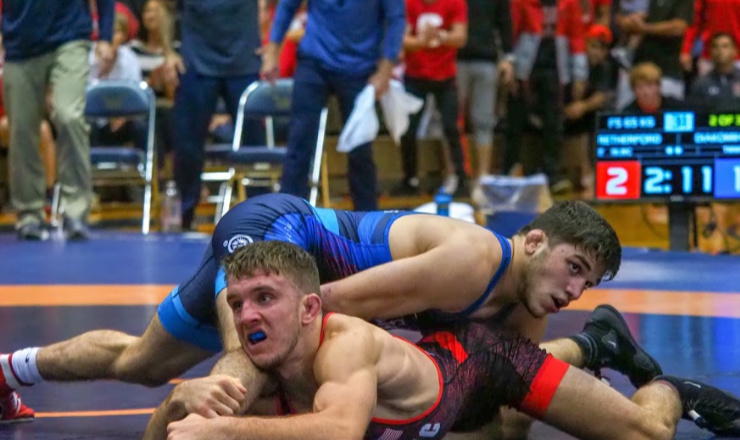
 Zain Retherford edged Yianni Diakomihalis in a Special Wrestle-Off (Photo/Juan Garcia)
One of the things that attracted me to wrestling early on was the wrestle-off. If I wanted to be the varsity wrestler, then I had to beat the varsity wrestler. What could be fairer than that?
When my high school wrestling team conducted wrestle-offs each week, my assistant coach would referee the match, the manager would keep time, and the rest of the team would stretch quietly off to the side. The room was silent except for the squeaky sounds of shoes on the mat, the occasional whistle, and the hurried breaths of kids desperate to make the lineup. We didn't cheer when one wrestler won because it was more important to hold up our teammate who was going to be spending Saturday watching from the bleachers.
The wrestle-off was sacred.
The United States freestyle team recently returned from a somewhat disappointing performance in Kazakhstan. Let me put this in perspective: The United States still finished third in the world as a team, earned two individual gold medals, and Kyle Snyder and Jordan Burroughs both bounced back from semifinal heartbreakers to claim bronze; those are all things worth celebrating. But when you compare it to two years ago when the United States won the whole darn thing, it feels as if the Americans took a step backwards this year. In addition, only two of the six weight classes are qualified for the Olympics.
Looking ahead to Tokyo 2020, I find myself questioning how we select World and Olympic teams. Even though I've always loved the fairness and transparency associated with the Final X wrestle-off series, I wonder if we are actually selecting the best team.
Allow me to pose a fundamental question: What does winning a wrestle-off actually mean?
In the college wrestling room, I came to learn that the wrestle-off wasn't quite as hallowed as it was in high school. I remember watching an experienced senior defeat a highly touted freshman in a wrestle-off for the 149-pound spot. Even though he'd been beaten fair and square, my coach started the freshman anyway, and shuffled the senior up a weight class to 157 pounds. In the end, both wrestlers ended up qualifying for the NCAA tournament that year, and that freshman ended up being a two-time All-American. Although at the time I thought it seemed wildly unfair, I realize now that the word, "fair," wasn't in my coach's vocabulary.
Most college coaches still conduct wrestle-offs to inform their lineup decisions, but unlike a lot of high school coaches, they'll also consider other data as well. For instance, that freshman had outplaced that senior at a preseason open tournament. That freshman also had a win over a common opponent who'd beaten the senior. After all, these two were training partners and practiced with each other every day. My coach took their wrestle-off with a grain of salt, and ultimately decided that there was more information to indicate that the freshman was his better option.
The United States' Trials wrestle-off series is fair, but it does not allow the coaches to consider any other information. I have some serious questions about two weight classes in particular: 65 kilograms and 86 kilograms.
At 65 kilograms, Zain Retherford went 0-1 in Kazakhstan. In this calendar year alone, Yianni Diakomihalis took gold at the renowned Yasar Dogu international tournament, beat Retherford twice, and defeated not one, but two wrestlers who won world medals in Kazakhstan. Now if we want to argue about fairness, then there is no question that it should have been Retherford's spot. He won the right to represent Team USA. No question.
But let's not talk about fairness. Instead, let's discuss the point of a team selection process. Should the objective be to ensure we have a fair process? Or should the goal be that we send the best team possible? At the highest levels, matchups matter more, and while Zain has proven that he matches up well against Yianni, Yianni has proven that he matches up better against the rest of the world.
At 86 kilograms, David Taylor, the 2018 world champion, announced he was out with an injury right before Final X was set to happen. It was too late in the process for 92-kilogram wrestlers to drop down to 86 kilograms, or for 79-kilogram wrestlers to bump up to wrestle off for that spot.
If the process was actually about selecting the best team, the United States would have figured out a way to move wrestlers around (like when my college coach moved that senior up a weight class). We became prisoner to our own system, and as a result we were not as strong as we could've been.
 Pat Downey after winning the U.S. Open title (Photo/Larry Slater)
Pat Downey III earned the spot fair and square, and he wrestled awesome in Kazakhstan and did his country proud, but I am still not convinced he was the best option for the United States. The world's No. 2 79-kilogram wrestler, Alex Dieringer, was waiting in the wings.
Now let's look at Russia. Russia's team selection process is anything but transparent. It has grown more ambiguous and convoluted over the past two years. Their federation all but handpicks who gets to wear the Russian singlet.
Many American wrestling pundits have criticized how Russia selected its team. In fact, three of their wrestle-offs this year were held in secret, behind closed doors, with just the wrestlers, coaches, and referees present in the room. Some of the weights didn't even have wrestle-offs.
Whereas the United States selects its team by honoring the results of a contest, which is what is best for the individual wrestlers involved, Russia operates more like an American Division I college wrestling program, which is what is best for the overall team. There was no way that they were going to keep Zaur Uguev, Gadzhimurad Rashidov, Abdulrashid Sadulaev, or Zaurbek Sidakov off the team based on the results of a wrestle-off, and all four won gold medals.
Dzhambulat Tedeev, the Russian coach, was never concerned with, "fair," and I'd be willing to bet that the world "spravedlivost," the Russian word for "fair," probably isn't in his vocabulary, either. Russia medaled in nine of the ten weight classes, and they won gold in five. They were 96 points ahead of the United States. Should we still be criticizing their process? Perhaps the Russian coaches are wondering why the heck the United States left some of its best talent at home.
Instead of honoring the results of the wrestle-off blindly, let's empower coaches to tap into their vast experience to allow the results of the wrestle-offs to inform rather than dictate the process for selecting the team.
So what does winning a wrestle-off actually mean? Well, it means a lot, but it shouldn't mean everything.

Same thing with Greco, Greco trials should be held a month after freestyle so that the works champ that is runner up in freestyle can try out for Greco.
1 RUS
2 KAZ
5 GEO
7 AZE
8 UZE
I also like the suggestion of "Uiowa1996". For lack of better terms (and I know there are some exceptions to the rule), the U.S. Greco-Roman has become the JV of the U.S. freestyle team. Many guys that don't have a shot at winning the World Team Trials or Olympic trials for freestyle try Greco-Roman as a backdoor way to make it to the Olympics and World Teams for the U.S. I believe it may have been "Uiowa19996" on a previous post that stated, "Imagine when World Champions David Taylor and Kyle Dake could not break the World and Olympic Team lineups with Olympic Gold Medalist Jordan Burroughs in front of him and eventual 2x World Champion J'Den Cox in front of them if they had an opportunity to try out for the Greco-Roman team?" I agree that Greco-Roman should have its trial perhaps a month after freestyle to allow for our top-level talent that does not make freestyle to try out for Greco-Roman. Even two weeks after, but I think an ideal period would be a month after.
I would like you to opine on the following scenario.
Zain wins the wrestle off, but Yianni gets selected based on the "Theory" we are sending our best team (which for the record I think is a ridiculous theory considering Zain won the wrestle off, so he was the best at that weight)
Yianni then goes out and gets beat in the first round.
What is your commentary then?
USA gymnastics, for instance, has a similar team qualification process for the 2020 US Olympic team including placing at the US Women's gymnastics championships or the US Olympic Gymnastic team trials. However, they also have the following bullet point in their team qualification process: "In addition, the 2020 Olympic Games Team Preparation Camp may also be used to determine/finalize nominations to the team..." I take this to mean that if they have an athlete like Simone Biles, and if that athlete were to trip during her floor routine at the US Open, and then were she to roll her ankle during training before the Olympic Trials, that the coach still reserves the right to put her on the team. If the coach put her out there at the Olympics in Tokyo, and if she bombed and didn't earn a medal, the coach would have to answer questions as well. The coach would likely say all the data pointed towards Simone being the best option even though she didn't qualify in the traditional method. I don't know a lot about gymnastics, but I do think that gymnastics is similar to wrestling in that it's an individual sport with a team component. I also know that the US consistently wins gold as a team, so I think it's worth examining how they select their team.
Now this isn't to say that Yianni is to wrestling what Simone Biles is to world level gymnastics (at least not yet), but I do think it's interesting that their qualification process includes this "team camp" option to bypass the traditional team selection process. They're willing to let their coaches answer to the media and angry fans if their gamble doesn't pay off.
Cael Sanderson and Tom Brands and Jon Smith make unique lineup decisions every year based on the needs of their team, and they make those decisions knowing they'll have to own those choices if they don't pan out in the end.
But really, and I truly mean this, I'm okay with the current process (I'm a big Zain actually), I just think we need to acknowledge as a community that our current process is what's best for the individual, but won't always be what's best for the overall team.